



Self-Contained vs Remote Walk-In Refrigeration Units
Walk-in cooler refrigeration units explained: how the evaporator and condensing unit work, self-contained vs remote systems, and Ontario 313A install rules.
Type “walk in cooler refrigeration unit” into a search bar and you get product listings with no explanation of what you are actually buying. This guide fixes that. It covers how the refrigeration system on a walk-in cooler or freezer actually works, the difference between self-contained and remote condensing units, what decides the size of the system, and the rules that apply when the box is installed in Ontario.
Key takeaways
- Every walk-in system has two halves. The evaporator inside the box absorbs heat; the condensing unit (compressor plus condenser coil) rejects that heat somewhere else. Where the condensing unit sits defines the system type.
- Self-contained means one packaged unit. Both halves ship as a single factory-charged package mounted on the box. Simpler install, lower cost, but the heat and noise stay in the building.
- Remote means a split system. The condensing unit moves to a roof, mechanical room, or outdoor pad, connected by refrigerant lines. Quieter and cooler inside, at a higher install cost.
- Sizing is a load calculation, not a chart lookup. Box volume, panel R-value, ambient temperature, door traffic, and product load all feed the required capacity.
- Ontario adds two credentials. Refrigeration work here is done by 313A-licensed refrigeration mechanics, and anyone handling refrigerant needs ODP certification.
How a walk-in refrigeration unit actually works
A walk-in refrigeration system is a loop that moves heat from inside the box to somewhere outside it. Refrigerant absorbs heat as it evaporates inside the cold room, then releases that heat when it is compressed and condensed on the warm side. Four components run that loop:
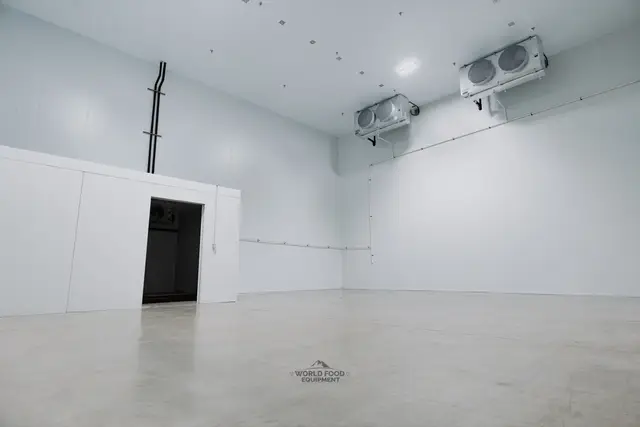
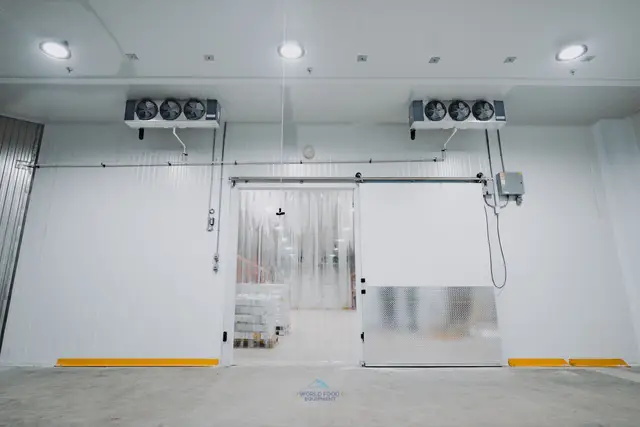
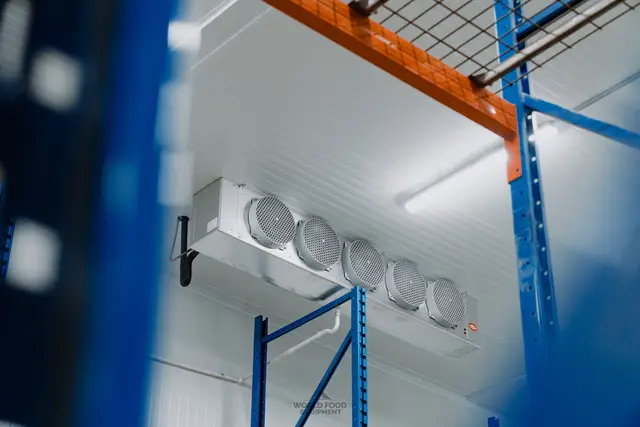
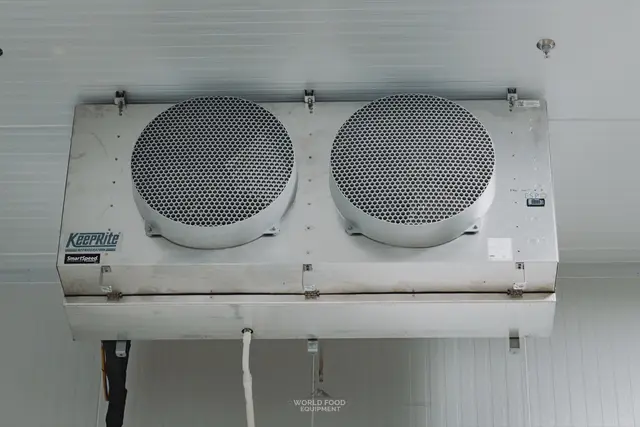
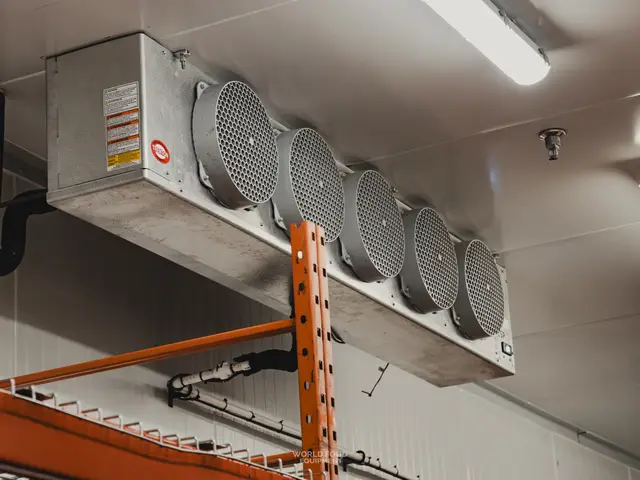
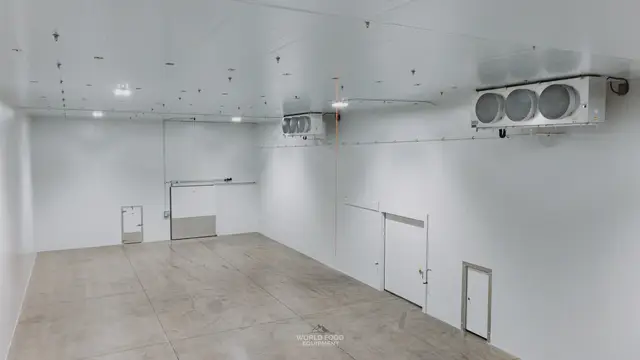
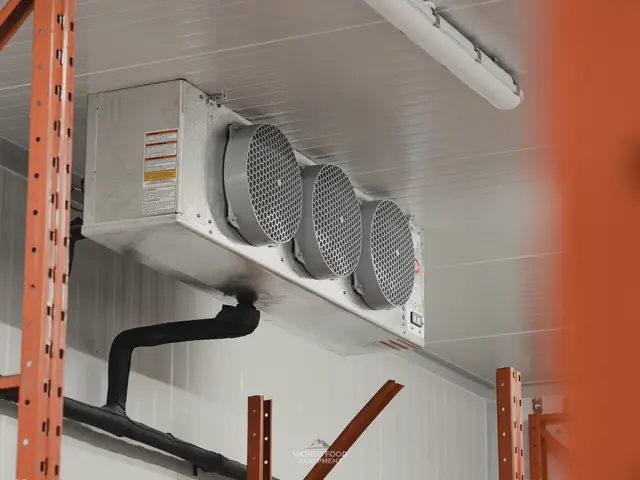
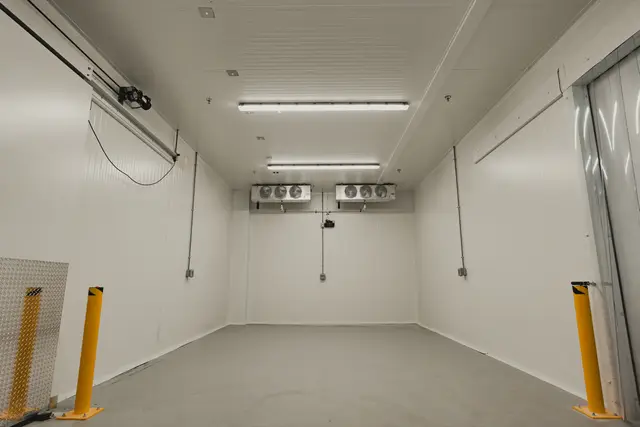
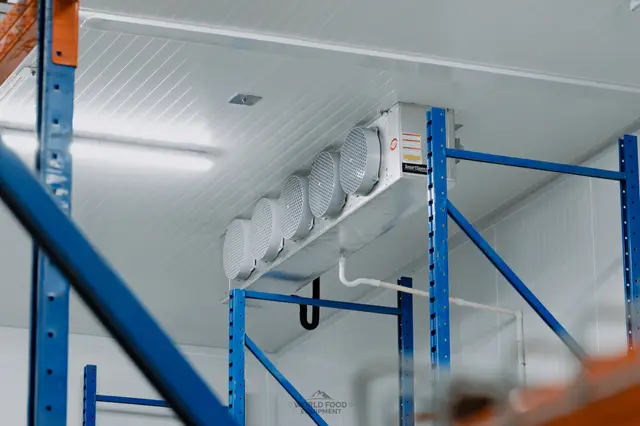
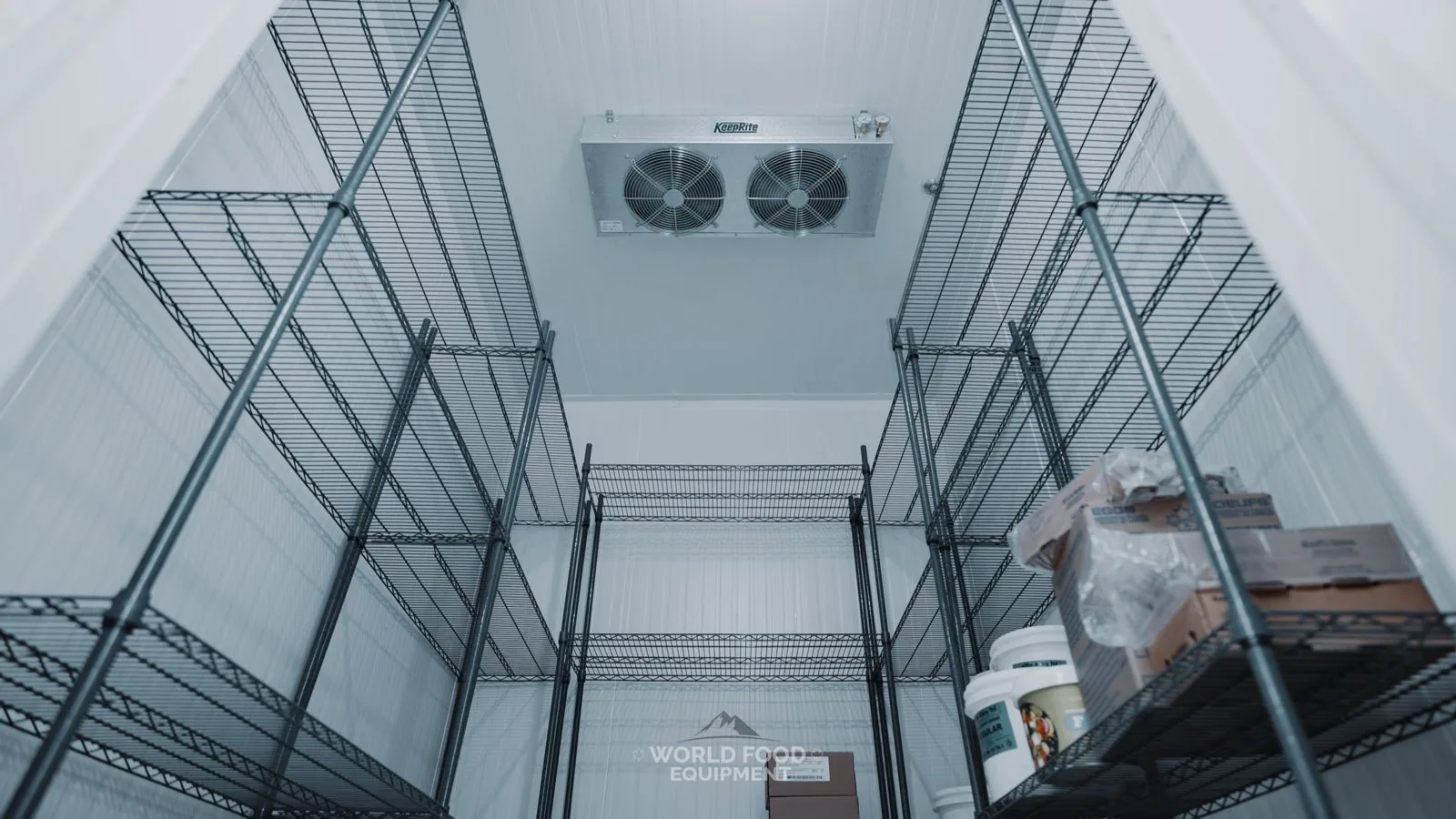
- Evaporator: the finned coil and fan unit mounted inside the box, usually on the ceiling. It blows air across the cold coil, pulling heat out of the room and the product. The photo above is a KeepRite evaporator on one of our Toronto cooler installs.
- Compressor: the pump of the system. A walk-in cooler compressor draws low-pressure refrigerant vapour from the evaporator and compresses it to high pressure, which is what makes heat rejection possible. We spec Copeland and Tecumseh compressors on our builds.
- Condenser: the coil and fan on the warm side that dumps the absorbed heat into surrounding air.
- Expansion valve: the metering device that drops the refrigerant pressure back down so the cycle can repeat.
The compressor and condenser are packaged together as the condensing unit. That single fact drives the whole self-contained versus remote decision, because the condensing unit is the half that makes noise, throws heat, and needs service access.
Self-contained refrigeration units
A self-contained system packages the evaporator and condensing unit into one factory-assembled, factory-charged unit, usually mounted through the ceiling or wall of the walk-in. US efficiency law calls this a single-package dedicated system: a single assembly containing the compressor, the condenser, and the refrigerated-air side, with nothing external added. There are no refrigerant lines to run on site, which is why these are often called plug-and-play systems.
Where a self-contained unit is the right call:
- Small to mid-size coolers: for a typical restaurant cooler, a packaged unit delivers the capacity needed without the cost of a line set and remote commissioning.
- Speed matters: no field brazing and no field refrigerant charge means a shorter install and fewer trades on site.
- Rented or leased space: the unit stays with the box. If the business moves, the walk-in and its refrigeration move together.
The trade-offs are physical, not subtle. The compressor’s heat rejects directly into the space around the box, so the kitchen HVAC absorbs it in summer.
The compressor also runs where staff can hear it. And in a low-ceiling kitchen, a top-mount unit needs clearance above the box to breathe.
Remote condensing units
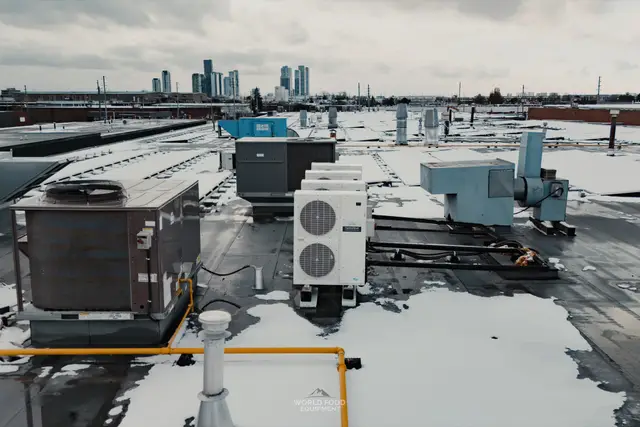
A remote (split) system keeps the evaporator inside the box and moves the condensing unit somewhere better: a roof, a mechanical room, or an outdoor pad. The same US regulatory catalogue covers this arrangement as a dedicated condensing unit or matched refrigeration system, which is a condensing unit paired with the unit cooler it serves. Refrigerant lines connect the two halves through the building, brazed and charged on site by the installing refrigeration mechanic.
What the extra install buys:
- The heat leaves the building: the condensing unit rejects its heat outdoors instead of into your kitchen ceiling, which matters most in July.
- The noise leaves too: walk-in compressors cycle around the clock. On a roof or pad, nobody hears it.
- Bigger capacity, better efficiency: larger boxes and freezers concentrate real refrigeration load, and a properly sized remote unit handles it with room to spare. Multiple boxes can also share a rack in larger builds.
- Easier service access: a technician works on a pad or roof unit without shutting down the kitchen underneath it.
The costs are real as well: a line set to run, penetrations through the building envelope, condensate and electrical to coordinate, and commissioning by licensed hands. On larger custom cold storage builds, remote refrigeration is the default rather than the exception.
Self-contained vs remote: the decision side by side
| Factor | Self-contained | Remote condensing unit |
|---|---|---|
| Install | Packaged, factory-charged, fastest | Line set, brazing, field charge |
| Heat rejection | Into the surrounding room | Outdoors or mechanical room |
| Noise | At the box | Away from staff and customers |
| Typical fit | Small to mid-size coolers | Freezers, large boxes, multi-box builds |
| Service access | At the box, above the ceiling | Roof, pad, or mechanical room |
| Relocation | Moves with the box | Fixed infrastructure |
Two rules of thumb from our installs:
- Default small, think remote as you grow. A compact indoor cooler rarely justifies a line set. Once the box gets large, holds freezer temperature, or sits in a kitchen already fighting its HVAC, remote starts paying back every month.
- Walk the heat path before quoting. The question is never just “which unit,” it is “where does the heat go.” If the answer is “into the prep area,” price the remote option before signing anything.
The restaurant walk-in cooler buyer’s guide covers how this decision fits alongside sizing, doors, and floors in a full purchase.
What size refrigeration unit does a walk-in need?
Capacity is measured in BTU per hour, and the number comes from a heat-load calculation of the kind laid out in the ASHRAE Handbook’s Refrigerated-Facility Loads chapter, not from box dimensions alone. The variables that drive the load:
- Box volume and panel spec: more cubic feet means more load, and a higher R-value envelope means less of it. The panel and R-value guide covers the envelope half of this equation.
- Temperature difference: a cooler holding 2°C in a 25°C kitchen works against a modest delta. A freezer holding minus 18°C works against roughly double the difference, which is why a walk-in freezer carries about twice the compressor of a same-sized cooler.
- Door traffic: every door swing trades cold air for warm, humid air the system must recondition. A delivery-door cooler in a busy kitchen carries a much bigger infiltration load than a rarely opened storage box.
- Product load: food that arrives warm has to be pulled down to temperature. A box that receives daily deliveries at ambient temperature needs capacity a holding-only box does not.
- Ambient conditions: a condensing unit on a black roof in July works harder than the same unit in a ventilated mechanical room.
Undersizing is the expensive mistake. A unit that cannot reach setpoint runs continuously, ices its evaporator, and fails early, and the failure usually arrives in the middle of a heat wave.
Oversizing wastes capital and short-cycles the compressor. This is why we size from the load questions above on every walk-in cooler install instead of quoting off a generic chart.
Ontario winters and outdoor condensing units
Ontario adds a wrinkle most spec sheets from warmer markets ignore: an outdoor condensing unit has to run at minus 20°C as reliably as it runs at plus 30°C. Cold weather drops the system’s head pressure below what the expansion valve needs to feed the evaporator properly, so an outdoor unit here is specced with the winterization hardware manufacturer installation manuals call for on low-ambient sites.
- Head pressure controls: flooding valves or condenser fan controls that keep the high side of the system at working pressure when the outdoor air is doing the condensing for free.
- Crankcase heater: keeps the compressor oil warm during off cycles so refrigerant does not migrate into the crankcase and wash out lubrication on startup.
- Wind and snow siting: the unit sits above expected snow depth, away from drifting, with clearance for airflow and service.
None of this is exotic. It is standard low-ambient practice on the KeepRite and Heatcraft condensing units we install.
It is also a checklist to hold any quote against if an out-of-province supplier is shipping you a box specced for a milder climate. Where the insulated box itself goes is a separate decision, covered in our guide to outdoor vs indoor walk-in cooler placement.
Refrigerants and efficiency standards are moving
The refrigeration half of a walk-in is regulated harder than the box itself, and the rules have been tightening on two fronts.
Efficiency first. Canada’s Energy Efficiency Regulations set minimum Annual Walk-in Energy Factor (AWEF) ratings for walk-in refrigeration systems: medium-temperature dedicated condensing systems made on or after January 1, 2020 must reach 5.61 AWEF indoors and 7.60 outdoors, and freezer condensing systems and unit coolers made on or after July 10, 2020 have their own floors. The US federal rule uses the same values; DOE published tougher system standards in December 2024, then withdrew that rule in May 2025, so those floors remain the ones in force.
The box side is covered too: the same regulations have set R-25 and R-32 floors for walk-in panels and doors made on or after June 5, 2017.
Refrigerant chemistry second. Since January 1, 2020, Canada’s halocarbon regulations have prohibited manufacturing or importing stand-alone medium-temperature commercial refrigeration systems with a refrigerant above a global warming potential of 1,400.
Condensing units are capped at a GWP of 2,200 under the same rules. That pushed the industry off older high-GWP blends; the US EPA’s SNAP program lists R-448A, R-449A, and CO2 among the acceptable substitutes in retail food refrigeration.
What this means for a buyer is simple: a new system from a current catalogue is built to current rules. The risk sits in old stock and used equipment, where a bargain condensing unit may be built around a refrigerant that is expensive to service. That is a question worth asking before buying any used walk-in equipment.
Who installs walk-in refrigeration in Ontario
Refrigeration is licensed work here, and that shapes who should be quoting your project.
- 313A refrigeration mechanics: Refrigeration and Air Conditioning Systems Mechanic is a compulsory trade in Ontario, so the brazing, charging, and commissioning on a walk-in system is done by licensed hands.
- ODP certification: anyone purchasing and handling refrigerants in Ontario needs an Ozone Depletion Prevention certificate under O. Reg. 463/10.
- Install versus repair: WFE installs new systems and complete walk-ins. If your existing unit is down and you are weighing a fix against a new box, start with the repair or replace assessment.
On our installs the refrigeration package is part of the roughly two-week build, commissioned and temperature-verified before handover, with the workmanship warranty on top of the manufacturer coverage. The temperature guide covers the setpoints we commission against.
Frequently asked questions
What is the difference between a compressor and a condensing unit?
The compressor is one component: the pump that pressurizes refrigerant vapour. The condensing unit is the assembly that contains the compressor plus the condenser coil and fan, packaged together on the warm side of the system.
When a quote lists a condensing unit, the compressor is inside it. The evaporator inside the box is always a separate component in that pairing.
What is a self-contained walk-in cooler refrigeration unit?
A self-contained unit packages the evaporator and the condensing unit into one factory-assembled, factory-charged piece of equipment mounted on the walk-in itself, usually through the ceiling or wall. Nothing is brazed or charged on site. It is the simplest system to install and the standard choice for small and mid-size indoor coolers.
When is a remote condensing unit worth it?
When the heat, the noise, or the load says so. A remote unit moves the compressor’s heat and sound out of the building, which matters for larger coolers, walk-in freezers, kitchens already at their HVAC limit, and customer-facing spaces. Larger and multi-box builds also concentrate enough refrigeration load that a remote system is the practical default.
Can a walk-in cooler condensing unit sit outside through an Ontario winter?
Yes, if it is specced for low-ambient operation. That means head pressure controls to keep the system at working pressure in cold air, a crankcase heater to protect the compressor oil between cycles, and siting above snow with clear airflow. An outdoor unit specced for a warmer market will struggle here, so confirm the winterization hardware is on the quote.
What size refrigeration unit does a walk-in cooler need?
The size comes from a heat-load calculation: box volume, panel R-value, the temperature the box must hold, door traffic, how warm product arrives, and where the condensing unit sits. Two identical boxes can need meaningfully different capacity once doors and product load are counted. Get the load calculated on your numbers rather than matched to a generic chart.
Who can install a walk-in cooler refrigeration unit in Ontario?
Refrigeration and Air Conditioning Systems Mechanic (313A) is a compulsory trade in Ontario, so the refrigerant side of a walk-in install belongs to a certified refrigeration crew, not a general contractor. The walk-in cooler installer licensing checklist covers the credentials and how to verify them by name.
Plan Your Build
Size your walk-in in the configurator.
Set dimensions, doors, and refrigeration in 3D, then download the spec sheet to share.
Read Next
Plan a Walk-In Cooler or Freezer in 3D: 8 Decisions
The eight decisions that shape every walk-in cooler or freezer, and where to make each one in our free 3D configurator: size, type, panels, floor, doors, refrigeration, racking and lights.
Industrial Walk-In Freezers: What to Plan Before You Build
What changes when a walk-in freezer gets big enough for pallets and forklifts: the slab, the clear height, the doors, the refrigeration plant, and the Ontario rules that start to apply.
Walk-In Cooler & Freezer Doors: Types, Sizes, Options
Swing, sliding, pallet and roll-up doors for walk-in coolers and freezers: which one fits your traffic, the sizes we build to, what a freezer door adds, and the Canadian rule every walk-in door has to meet.
Walk-In Coolers — Custom Builds
See the service page for sizing, anatomy, and what's included in a WFE install.