












Walk-In Cooler & Freezer Doors: Types, Sizes, Options
Walk-in cooler and freezer doors: swing vs sliding, common sizes from 34 x 78 inch to 6 x 8 ft, 3 and 4 inch leaves, heated frames, and Canada's R-25/R-32 rule.
A walk-in cooler door is the part of the box your staff use all day, and the main way warm air gets in. Pick the wrong type or size and you live with it for the life of the walk-in.
The choice comes down to what has to pass through the opening: a person with a case, a rack cart, or a forklift with a pallet. Get that right and the door type, the size and the freezer options follow.
Key takeaways
- Swing doors for most boxes: a hinged Coldmatic door with Kason hardware and self-closing cam-lift hinges is what we fit on restaurant and grocery walk-ins.
- Sliding doors for traffic: manual, electric, bi-parting, pallet and wicket sliders take over where carts, pallet jacks or forklifts move through.
- Sizes we build to: 34 x 78 and 36 x 80 inch swing doors, 5 x 8 and 6 x 8 ft sliders, with custom openings on any project.
- Freezer doors are thicker and heated: 4 inch leaves instead of 3, with heated frames and thresholds, and double gaskets for extreme low temperatures.
- Canada sets a floor: door assemblies made on or after June 5, 2017 must meet R-25 for coolers and R-32 for freezers.
Walk-in door types at a glance
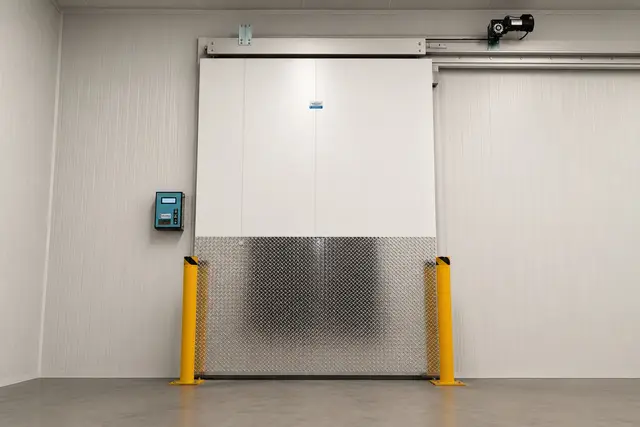
Most walk-ins need one of four door types, and the deciding question is what moves through the opening. People with cases and carts are served by a swing door; pallets, forklifts and constant traffic call for a slider. Very large or busy openings move to roll-up or vertical doors.
| Door type | Best for | Cooler or freezer | Worth knowing |
|---|---|---|---|
| Swing (hinged) | Restaurants, grocery, small processors | Both | Self-closing cam-lift hinges, inside safety release |
| Manual sliding | Wide openings with limited swing clearance | Both | No door arc to block an aisle |
| Electric or bi-parting sliding | Distribution and processing with steady traffic | Both | Motorized operator with a safety edge |
| Pallet or wicket door | Forklift openings that also need a person door | Both | The wicket lets staff walk in without opening the full leaf |
| High-speed roll-up or vertical lift | Large cold rooms and warehouse freezers | Cooler-rated roll-up, vertical freezer doors | Quoted per project for big openings |
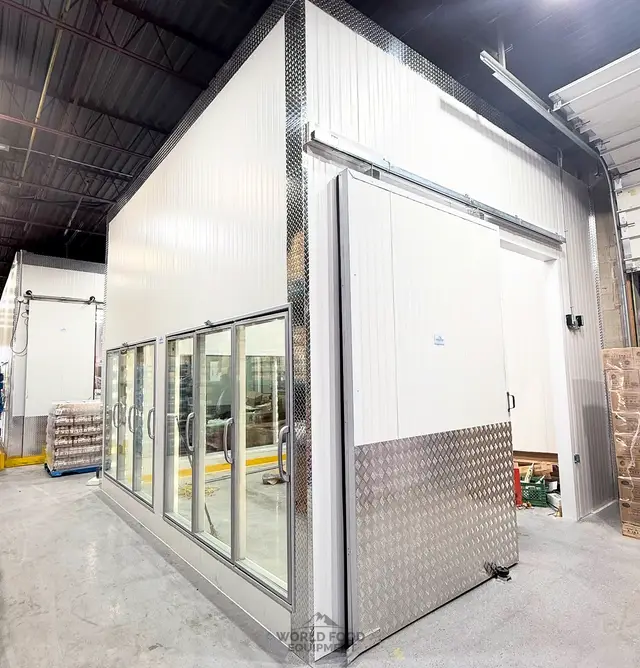
If you want product on show behind glass, that is display refrigeration rather than a walk-in passage door. Canada treats a door that is 75% or more glass as a separate display door assembly, and our reach-in and display refrigeration page covers that side.
Swing doors: the standard on most walk-ins
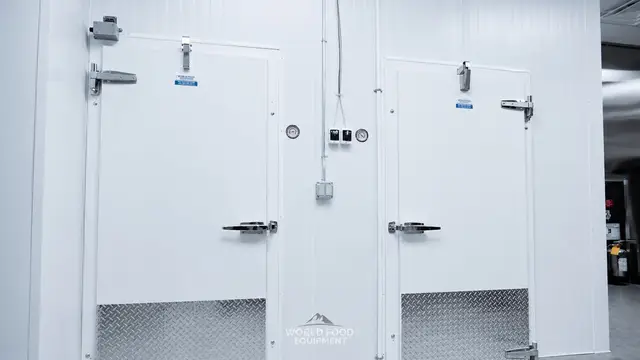
A swing door is the default for most walk-in coolers and freezers up to restaurant and grocery scale. It is the simplest door to build, seal and service, and its hardware is standard parts. The walk-in coolers we supply ship with Coldmatic swing doors on Kason hardware, custom manufactured to fit the opening.
- Self-closing cam-lift hinges: the leaf rises as it opens and drops back onto the gasket as it closes, so a door let go near the frame pulls itself shut.
- Magnetic gasket system: a magnetic perimeter gasket seals the leaf to an aluminum wrap-around frame.
- Interior safety release: every swing door has a release that opens from inside the box.
- Construction: heavy-duty insulated core, minimum G60 galvanized steel, epoxy pre-painted metal in a smooth or embossed finish.
- Thickness: 3 inch leaves on cooler doors, 4 inch on freezer doors.
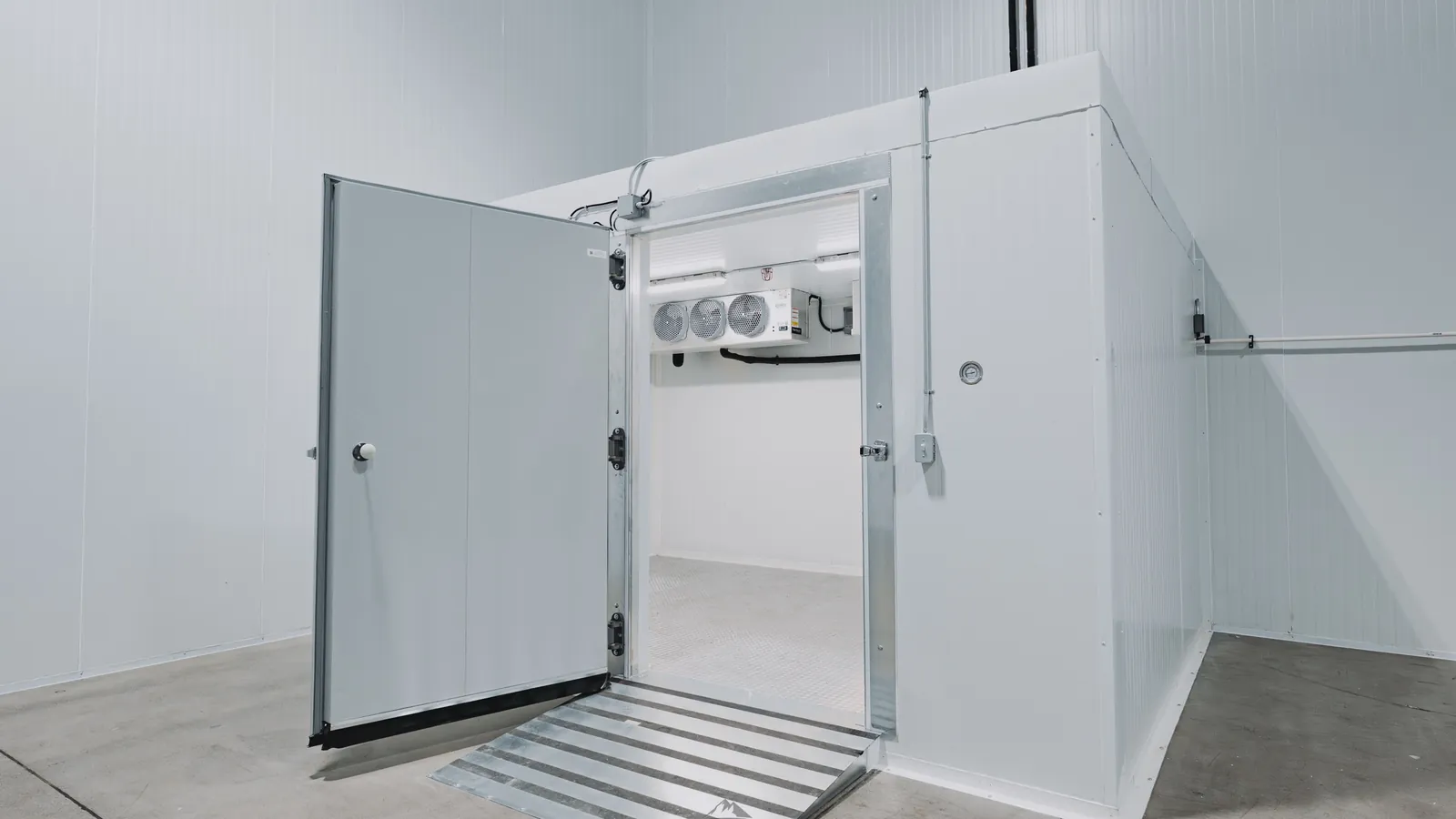
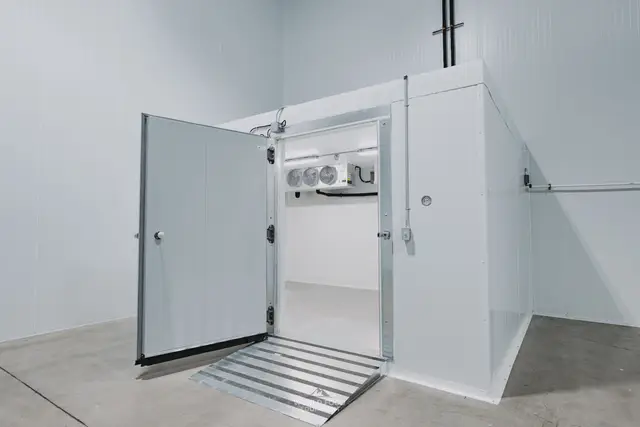
The swing door in the Pacer Air Freight photo hangs on a cold room inside the 6,000 sq ft medical-grade build at Pacer Air Freight in Mississauga, with an aluminum ramp at the threshold so carts roll straight in. A swing door does need clear floor for the full arc of its leaf. Where that floor is an aisle or a prep line, a sliding door is the better fit even on a small box.
Sliding, pallet and wicket doors for traffic
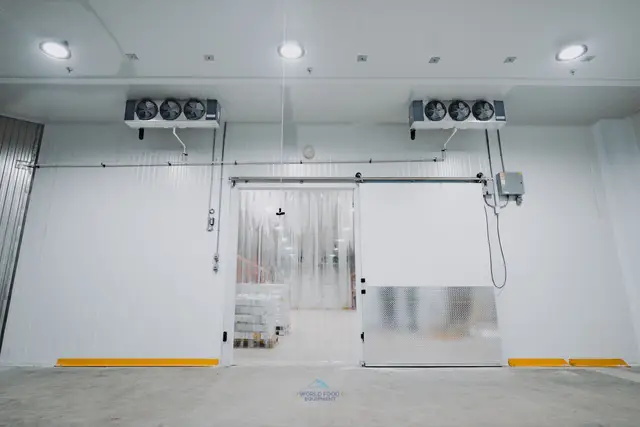
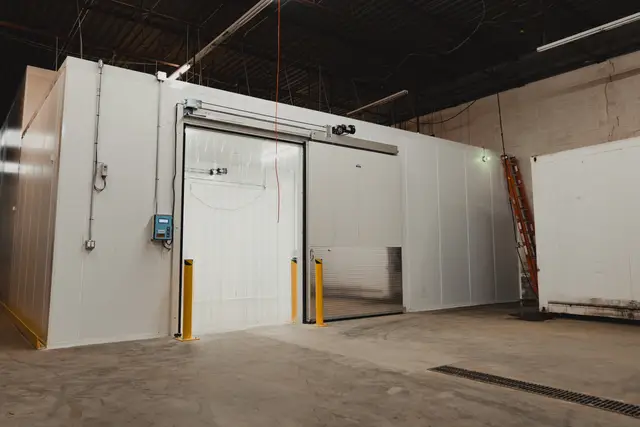
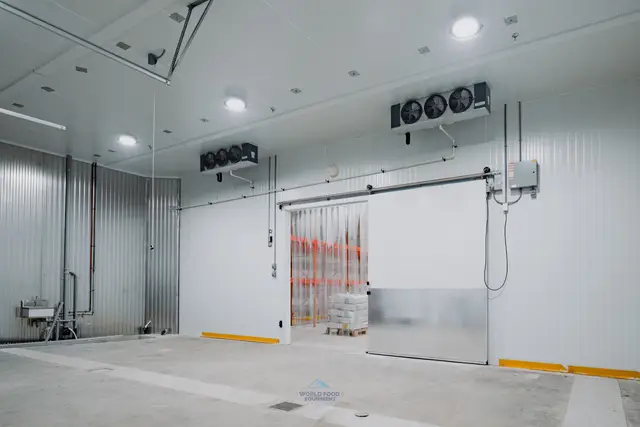
Sliding doors move along a track beside the opening instead of swinging into the room. That makes them the default for wide openings, pallet traffic and boxes where a swinging leaf would block an aisle. They come manual or electric, single-leaf or bi-parting, and in pallet and wicket versions for forklift work.
- Manual sliders: one leaf on an overhead track, the simplest choice for a wide opening with occasional traffic.
- Electric sliders: a motorized operator opens and closes the leaf, with a safety edge that stops it on contact. Our commercial electrical crew wires the operator and its controller.
- Bi-parting doors: two leaves part from the centre, so a wide opening clears faster.
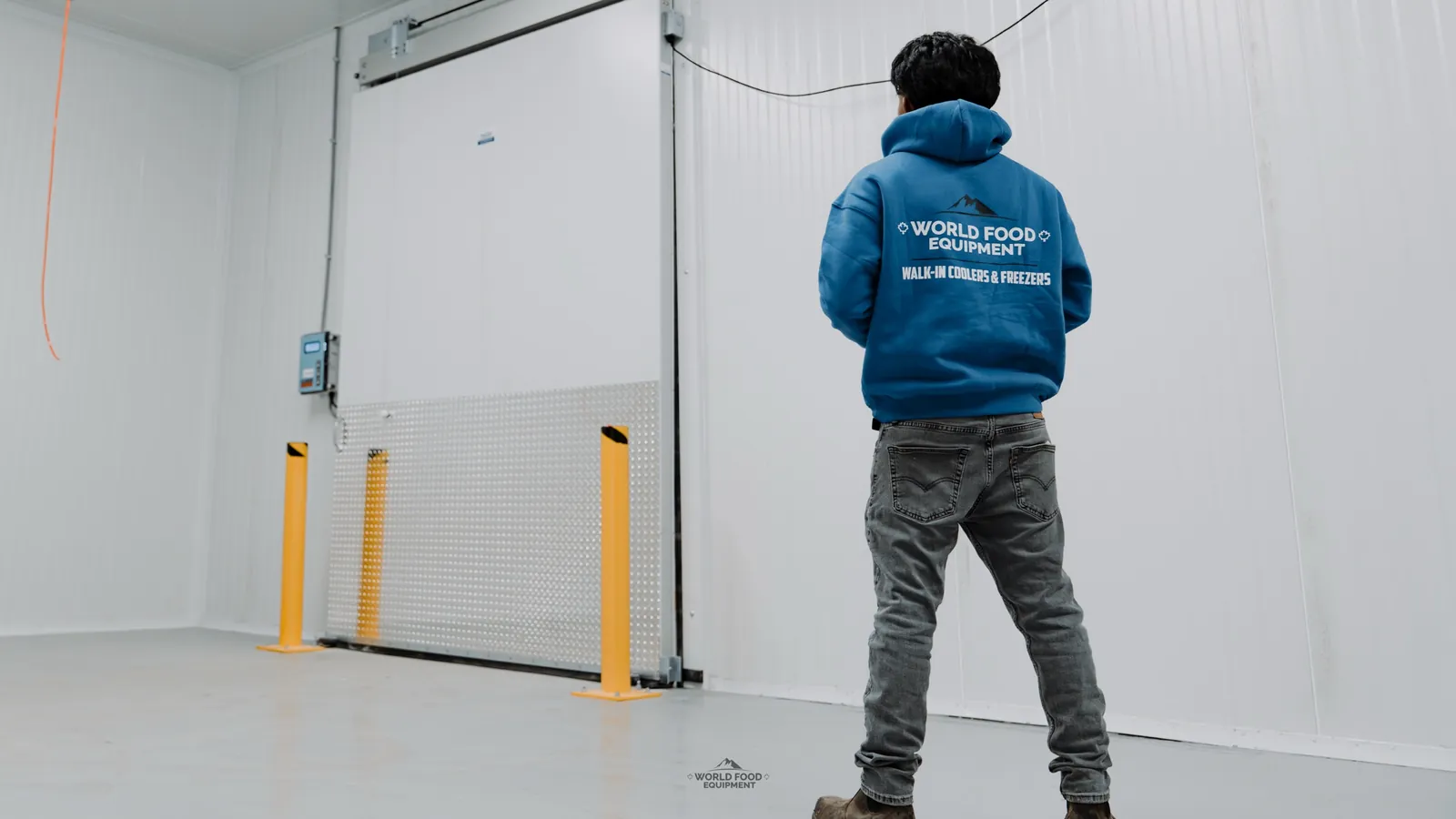
- Pallet doors: sized and built for pallet jacks and forklifts in distribution and processing freezers.
- Wicket doors: a person-size door set into a larger sliding leaf, so staff can walk in without opening the full door.
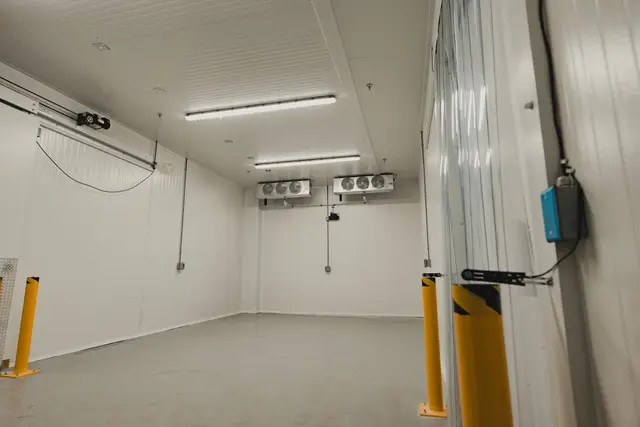
At SKOR Crestlawn, a school food supplier, product moves straight from a 1,500 sq ft processing area into a 3,000 sq ft freezer. Two fully automatic sliding doors keep staff and carts moving through the shift, with steel bollards across the high-traffic zones. The full build is written up as the SKOR Crestlawn installation.
Roll-up, vertical and high-speed doors
On large cold rooms and warehouse freezers the opening can outgrow any hinged or sliding leaf. High-speed roll-up doors suit busy cooler openings, and vertical lift or vertical sliding doors suit big freezer openings where the leaf has to move up rather than across. These are quoted per project as part of a custom cold storage build.
- High-speed roll-up: cooler-rated doors that open and close fast to keep the opening short.
- Vertical lift and vertical sliding: freezer doors that travel upward, freeing the wall beside the opening for racking.
- Air curtains and strip curtains: NRCan lists air curtains, especially recirculating models, and even strip curtains among the ways to cut warm air entering a walk-in.
What size is a walk-in cooler or freezer door?
Most walk-in cooler and freezer doors fall into a few standard sizes. Size the door to the largest thing that will pass through it, whether that is a rack cart, a pallet or a forklift with a load. The common sizes below cover most restaurant, grocery and distribution work, and larger openings are built to order.
| Door | Common sizes | Leaf thickness | Canadian class |
|---|---|---|---|
| Swing, cooler | 34 x 78 in, 36 x 80 in | 3 in | Passage door |
| Swing, freezer | 34 x 78 in, 36 x 80 in | 4 in | Passage door |
| Sliding | 5 x 8 ft, 6 x 8 ft (custom oversized available) | 3 in cooler, 4 in freezer | Freight door at 4 ft wide and 8 ft tall or more |
- Passage vs freight: Canada’s regulations define a freight door as one that is 1.22 m (4 feet) or more in width and 2.44 m (8 feet) or more in height. Anything smaller that is not a display door is a passage door.
- Closer benchmark: the US federal rule requires automatic closers on walk-in doors but exempts doors wider than 3 feet 9 inches or taller than 7 feet. A standard 34 x 78 or 36 x 80 inch swing door sits under both limits, so the closer rule would apply to it.
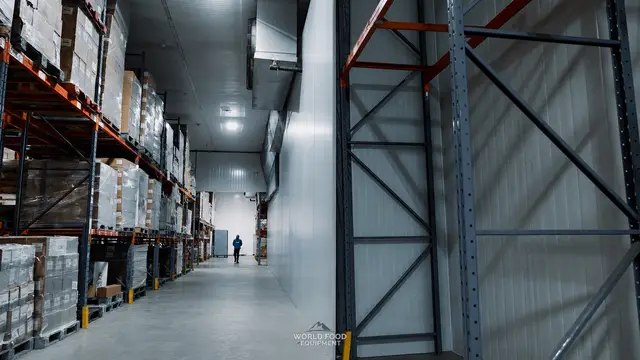
- Distribution scale: at Atlas Foods, a specialty food distributor, both rooms run 10 x 8 ft insulated sliders sized for pallet jacks and forklifts, with a forklift ramp into the insulated freezer floor.
- Frame materials: aluminum, white clad steel, stainless steel or high-density polymer (HDP), chosen for the room’s washdown and traffic.
What makes a walk-in freezer door different?
A walk-in freezer door has to seal against a box running well below zero, so it is built heavier than a cooler door. The leaf is 4 inches thick instead of 3, heat is added around the frame and threshold, and very low temperature rooms add a second gasket. Skip any of these and the door frosts, sticks or freezes shut.
- Heated frame and threshold: DOE’s test procedure describes the heater wire around a walk-in door as being for anti-sweat or anti-freeze use: it stops condensation and keeps the door from freezing shut.
- Pressure relief vent: a freezer pulls a slight vacuum after the door closes, and a heated relief port lets it equalize. DOE notes a heated relief vent on a freezer could need up to 23 W of heat to keep from freezing.
- Double gasket: an upgrade for extreme low-temperature rooms, where one gasket alone frosts over.
- Heater controls: NRCan says anti-sweat heater controls that sense humidity can improve system energy efficiency by two to four percent.
When ice starts building at the door of a running box, our guide to ice build-up in walk-in freezers walks through the door-side causes and who fixes each one.
Options and upgrades worth specifying
The standard door handles most rooms. A few upgrades earn their place in busy, wet or forklift-heavy facilities, and they are much easier to order with the door than to retrofit later. These are the ones we specify most often.
- Hinge side: a swing door is built left-hand or right-hand to suit the opening, so decide which way it should open before it is ordered.
- Thresholds and ramps: freezer doors get a heated threshold, and where a box sits on an insulated floor, an aluminum ramp at the door lets carts roll in.
- Kick plates: a diamond-plate or stainless lower face that takes cart and boot strikes.
- Vision windows: a window in the leaf so staff can see who is on the other side before opening.
- Stainless steel finishes: stainless frames and door skins for washdown rooms in food processing.
- Heavy-duty traffic-rated hardware: heavier hinges and latches for doors that cycle all shift.
- Strip curtains: NRCan recommends a strip curtain and automatic door closers on high-traffic units to cut the heat load on the compressor.
- Door-open alarms: an alarm on a freezer slider that sounds when the door is left open.
- Bollards: steel posts that keep forklifts off the track and frame, as on the SKOR Crestlawn freezer.
Canada’s rules for walk-in doors
Walk-in door assemblies are federally regulated in Canada. NRCan’s Energy Efficiency Regulations cover door assemblies and panels manufactured on or after June 5, 2017, with an insulation floor that matches the US prescriptive R-25 and R-32 values. Buy from a manufacturer that certifies its doors, and check the nameplate.
- Insulation floor: passage and freight doors need RSI 4.40 (R-25) on coolers and RSI 5.64 (R-32) on freezers. Display doors are held to a daily energy limit instead.
- Nameplate: doors made on or after June 26, 2017 carry a nameplate, in English and French, with the brand and whether the door is for a cooler, a freezer or both.
- Same numbers south of the border: the US rule asks for door insulation of at least R-25 for coolers and R-32 for freezers, plus strip doors, spring-hinged doors or another way to cut infiltration when a door is open.
- Inside release: check it works on every box. A long-standing WorkSafeNB hazard alert describes a worker trapped in a restaurant freezer for about three hours because ice had formed around the release push rod.
Panels fall under the same regulation, and our guide to walk-in panel R-values covers that side.
Keeping a walk-in door working
A walk-in cooler or freezer door takes more wear than most parts of the box, and almost every wear part can be replaced without replacing the door. WFE stocks the parts, and our 313A-licensed technicians fit them on any brand of walk-in. Here is who handles what.
- Gaskets, hinges, latches and closers: standard and custom-cut gasket profiles, cam-lift hinges, magnetic latches, door closers and heated frames for swing and slide doors are on our refrigeration parts page.
- A leaking gasket or a door that will not seal: this is usually a one-visit job. Book it through walk-in cooler and freezer repair.
- Frame heaters and operators: a dead freezer frame heater or a sliding-door operator fault is booked the same way, and the parts for both are stocked.
- Scheduled checks: door gaskets, closers, and hinges are on the checklist of every walk-in maintenance visit.
- The paper test: NRCan’s check is simple. “If a sheet of paper placed in the door slides around or slips out, or if light from a flashlight placed inside can be seen through the seals, replace the seals.”
- Used doors: a refurbished door in a standard size, like the Coldmatic 34 x 78 walk-in door on our used list, can fit an existing opening. Our used walk-in buying guide covers how to check a door before you buy it.
Choose a walk-in cooler door or freezer door for the traffic the room will carry in five years, not the cart you push today. Send us the opening size and what moves through it, and we will spec the door with the rest of the box.
Frequently asked questions
What size is a standard walk-in cooler door?
The most common walk-in cooler swing doors are 34 x 78 inches and 36 x 80 inches. Sliding doors for pallet traffic usually start at 5 x 8 or 6 x 8 feet. Every door we supply is custom manufactured to its opening, so size it to the largest cart, pallet or load that has to pass through.
How thick is a walk-in freezer door?
Walk-in freezer doors are typically 4 inches thick, against 3 inches for a cooler door. Canada requires passage and freight doors on walk-in freezers to reach RSI 5.64 (R-32), compared with RSI 4.40 (R-25) for coolers, for door assemblies made on or after June 5, 2017.
Should a walk-in have a swing door or a sliding door?
A swing door suits most restaurant and grocery walk-ins: it is simple, self-closing and easy to service. Choose a sliding door when the opening is wide, when pallets or forklifts move through, or when a swinging leaf would block an aisle or prep line in front of the box.
Can you replace just the gasket on a walk-in door?
Usually, yes. Gaskets, cam-lift hinges, latches, closers and heated frames are all replacement parts on a walk-in door, so a door that no longer seals rarely needs replacing. A leaking gasket is normally a one-visit job for a 313A-licensed technician, on any brand of walk-in.
What is a wicket door on a walk-in freezer?
A wicket door is a person-size door built into a larger sliding or pallet door. Staff can walk in and out through the wicket without opening the full leaf, which keeps the big opening closed and the warm air out between forklift loads.
Do walk-in doors need an inside release?
Yes. Every walk-in swing door we install has an interior safety release so the door opens from inside the box. Test it regularly on a freezer: a WorkSafeNB hazard alert describes a worker trapped for about three hours after ice formed around a release push rod.
Plan Your Build
Size your walk-in in the configurator.
Set dimensions, doors, and refrigeration in 3D, then download the spec sheet to share.
Read Next
Industrial Walk-In Freezers: What to Plan Before You Build
What changes when a walk-in freezer gets big enough for pallets and forklifts: the slab, the clear height, the doors, the refrigeration plant, and the Ontario rules that start to apply.
Walk-In Cooler Not Cooling? What to Check First
A warm walk-in gives you a short window. What to do with the product, the checks an operator can make safely in ten minutes, what each symptom points to, and where Ontario law hands the job to a licensed mechanic.
Buying a Used Walk-In Cooler or Freezer: What to Check
Wet foam, missing cam-locks, a dead frame heater, or an R-22 condensing unit can turn a cheap used walk-in into an expensive one. The inspection order that catches each fault, what a refurbished warranty covers, and what happens when you move a used box.
Walk-In Coolers — Custom Builds
See the service page for sizing, anatomy, and what's included in a WFE install.