






Walk-In Cooler Not Cooling? What to Check First
Walk-in cooler not cooling? Probe the food first (Ontario's line is 4°C), check the door, airflow and condenser, and know what needs a 313A tech.
A walk-in cooler that is not cooling gives you a short window. The product inside is warming toward Ontario’s 4°C line, and most of what could be wrong is not yours to work on.
This guide covers the part that is yours: protecting the food, the checks an operator can make safely in about ten minutes, and what each symptom points to. It also marks where Ontario law hands the job to a licensed refrigeration mechanic (313A).
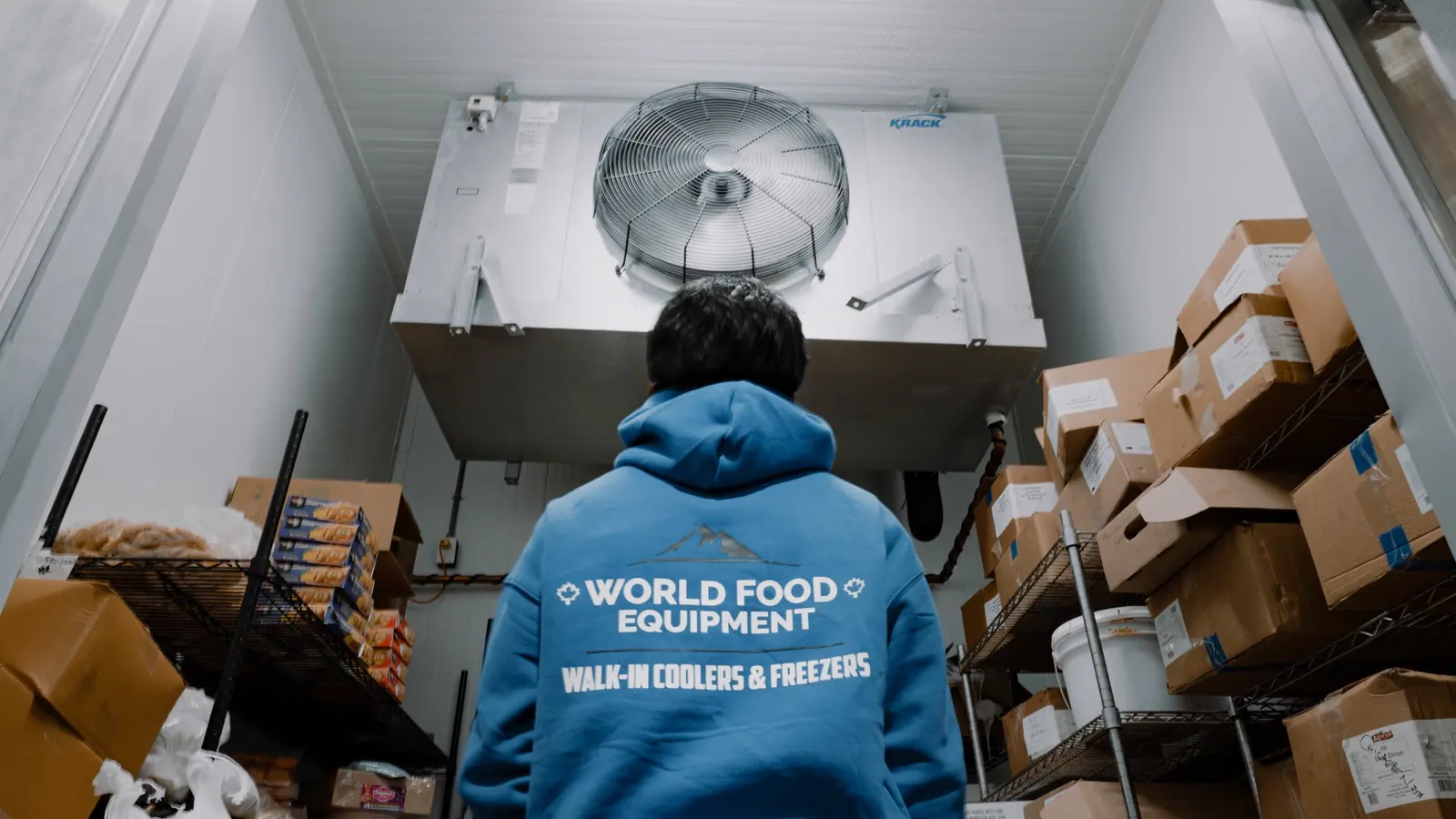
Key takeaways
- Food comes first: Ontario’s Food Premises regulation holds potentially hazardous food to 4°C or lower. Probe the product, not the air, and start moving stock before you start diagnosing.
- Operator checks are airflow: a door that does not seal, product stacked against the evaporator, a condensing unit choked with debris. None of them needs a tool.
- Symptoms narrow the cause: silent fans, a silent compressor, and a warm box with everything running are three different faults with three different cause lists.
- Refrigerant is no top-up: under Ontario Regulation 463/10, a leak notice means “no person shall add a refrigerant to the equipment until the leak is repaired.”
- Licensed work stays licensed: refrigeration is a compulsory trade (313A) in Ontario, and electrical work belongs to licensed trades.
Walk-in cooler not cooling: protect the food first
Before anything mechanical, deal with the product. Ontario Regulation 493/17 requires potentially hazardous food to be stored at an internal temperature of 4°C or lower, and it offers no grace period for a broken cooler. The two-hour allowance in section 27 covers preparation, processing, and manufacturing only, so the regulation leaves no storage allowance once product reads above 4°C.
- Probe the product: the rule is written around “the internal temperature of the food”, so put a probe thermometer in the product itself. Air temperature swings faster than food does.
- Read the box thermometer: section 30 of the same regulation requires refrigeration equipment to “contain accurate indicating thermometers that may be easily read.” Write down the reading and the time.
- Keep the door shut: Health Canada’s power outage guidance says an unopened refrigerator “will keep food cold for about 4 hours.” That figure describes a household fridge, so treat it as a rough guide and let the probe decide.
- Move high-risk stock: dairy, meat, poultry, seafood, and cooked food go first, into another cooler, a reach-in, or a refrigerated truck.
- Discard on evidence: the same Health Canada page says to “throw away all food that has been at room temperature for 2 or more hours” and adds “When in doubt, throw it out.” If a discard decision is not clear, your public health unit is the authority.
- Log every reading: time-stamped temperatures are what let you, or an inspector, judge later which product stayed safe.
Health Canada places the temperature danger zone “between 4 °C (40 °F) to 60 °C (140 °F) where bacteria can grow quickly.” Everything in the rest of this guide happens after the product is safe.
What an operator can check safely in ten minutes
Most of what an operator can check comes down to air: air leaking in at the door, air blocked at the evaporator, and air blocked at the condensing unit. Every check below is a look or a listen. None of them involves opening a panel, touching wiring, or handling refrigerant.
- Setpoint and display: read the controller. Confirm nobody changed the setpoint, and note any alarm or fault code exactly as shown.
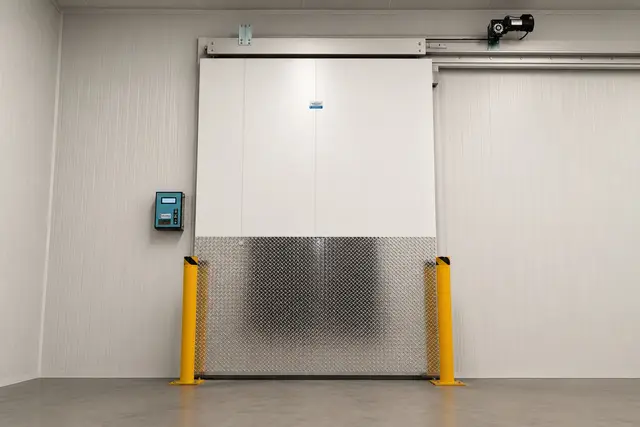
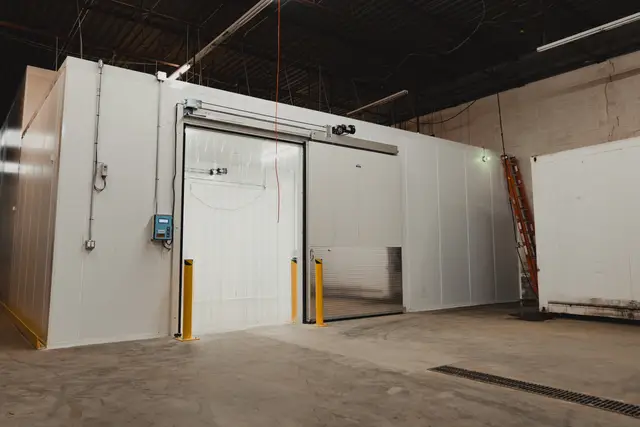
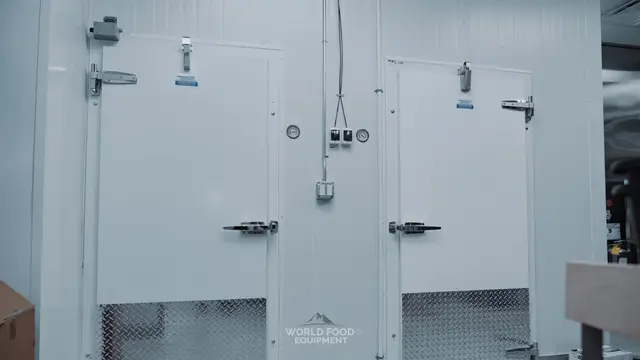
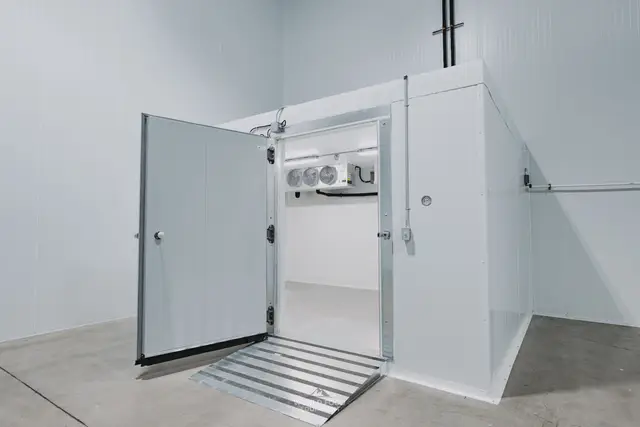
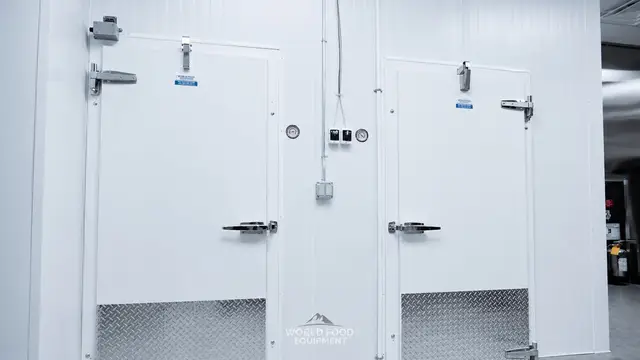
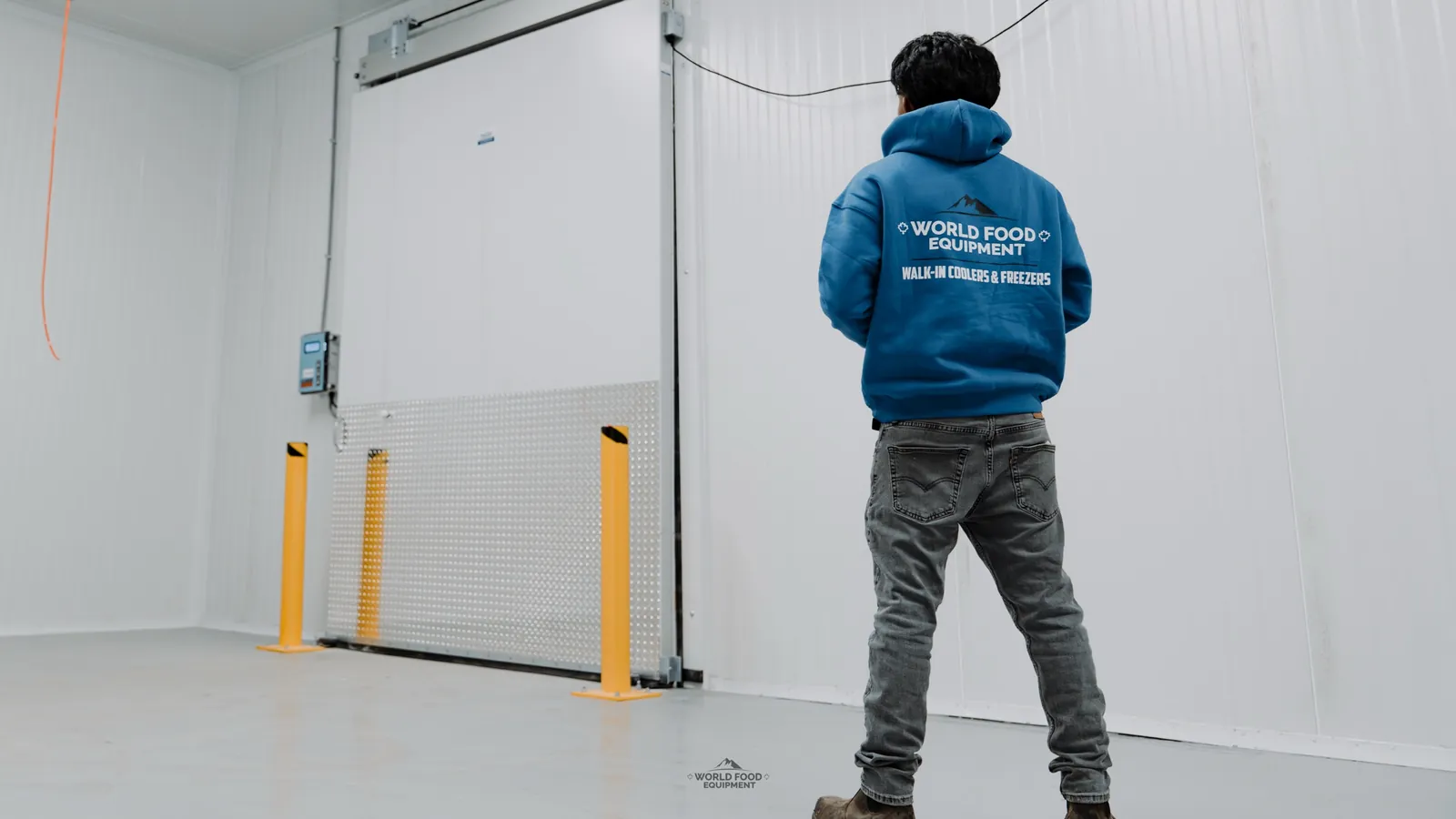
- Door and gasket: confirm the door closes and latches by itself, with nothing propped open or caught in the seal.
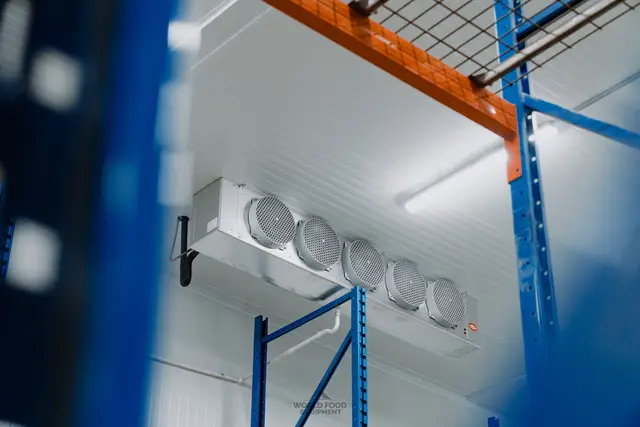
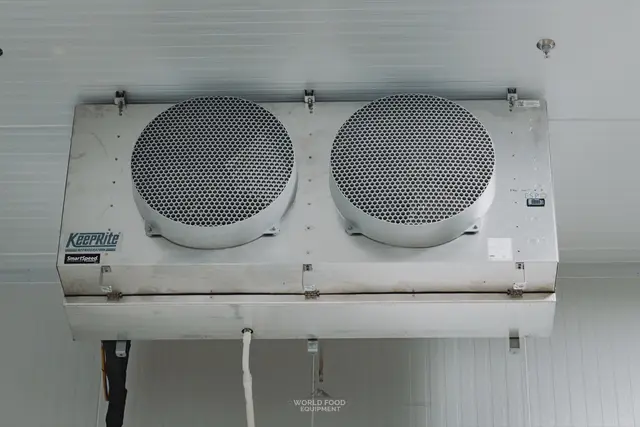
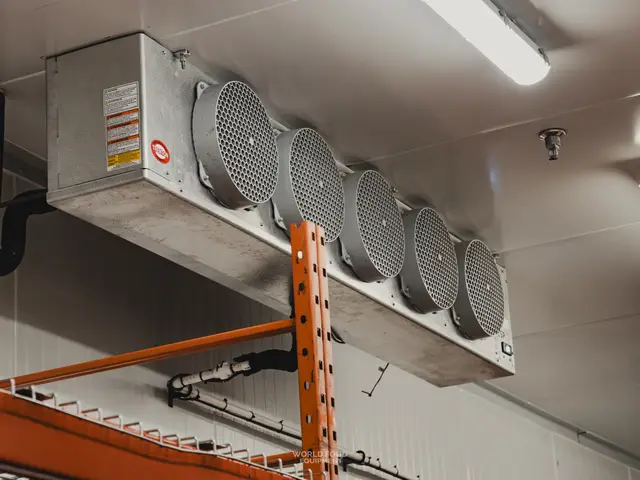
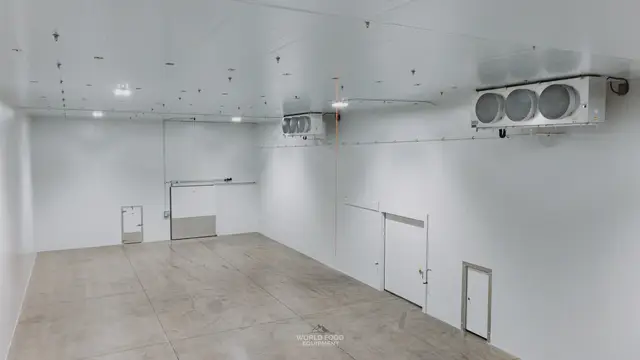
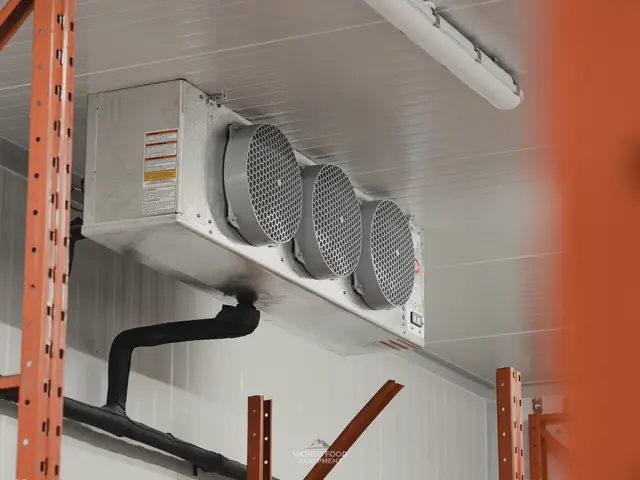
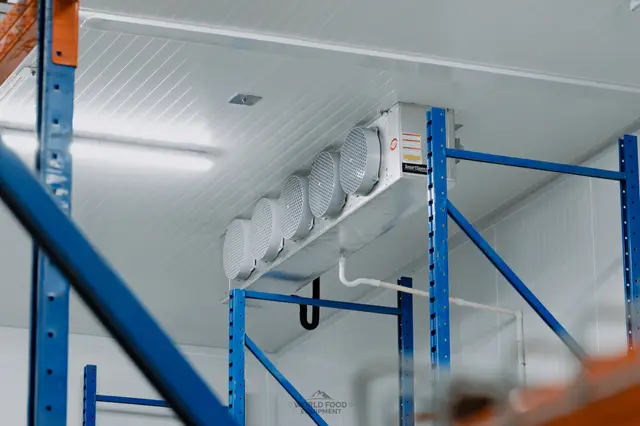
- Evaporator fans: stand inside and listen. Fans moving air in a warm box point one way, and silent fans point another.
- Coil face: look for an evaporator coil packed with ice. Do not chip it; our walk-in freezer ice guide explains what coil ice means and who clears it.
- Product placement: check that nothing is stacked against the evaporator or in front of its fans.
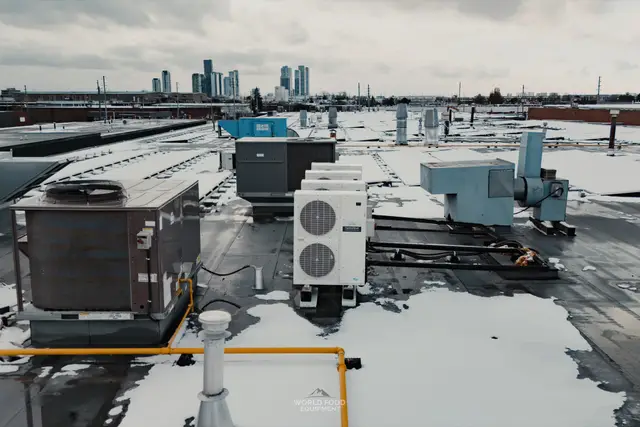
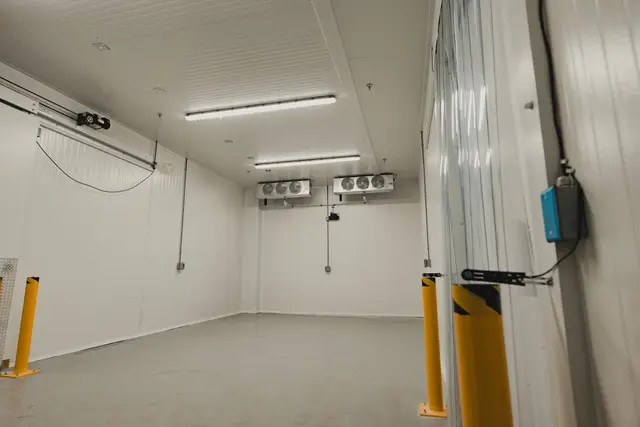
- Condensing unit: find it on the roof, an outside wall, or the top of the box, and look only from the ground or a permanent access point. Blocked airflow looks like cardboard, leaves, snow, or a coil face matted with dust and grease.
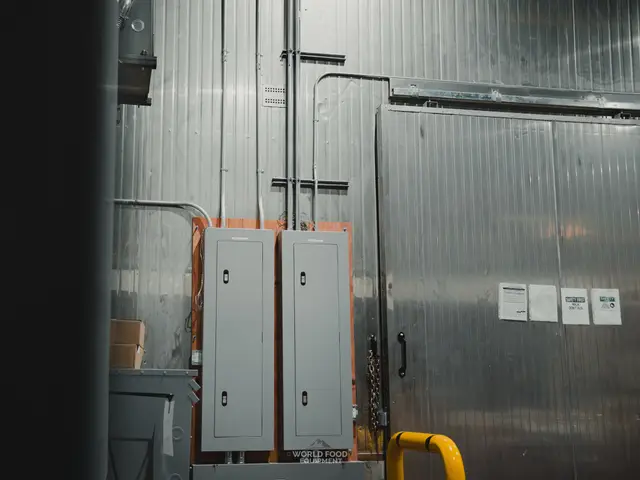
- Power, by eye: note whether the disconnect is on and whether a breaker has tripped. A tripped breaker is information for the technician. Leave it as found and report it.
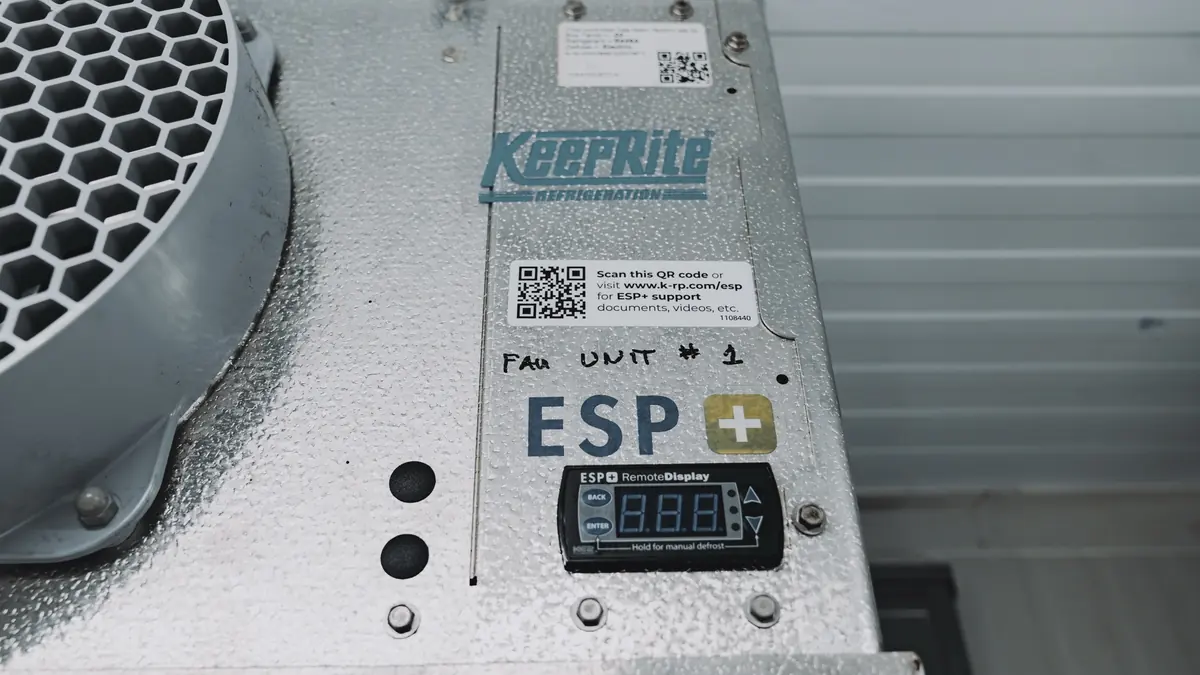
A controller like the one above normally shows the box temperature and any active alarm. Read it and write it down. Apart from restoring a bumped setpoint to a value you know is correct, leave every key and parameter alone, because defrost and fan settings are commissioning work.
What the fans and compressor are telling you
The symptom narrows the cause before anyone opens a panel. Heatcraft publishes troubleshooting charts in its unit cooler manual and its condensing unit manual, and the cause lists below come from those charts, except where a row names another source. Use them to describe the fault accurately on the phone, not to attempt the corrective steps, which are written for technicians.
| What you see | Causes the charts list | Who handles it |
|---|---|---|
| Room temperature too high | Thermostat set too high, system low on refrigerant, coil iced up, unit cooler too close to the door, heavy air infiltration | Setpoint, door, and airflow: operator. The rest: 313A mechanic |
| Evaporator fans not running | Main switch open, blown fuses, defective motor, defective timer or defrost thermostat, or the unit is in a defrost cycle | If the controller shows a defrost in progress, wait for it to end. Fans still silent afterward, or no defrost shown: call |
| Compressor will not run | Main switch open, fuse blown, thermal overloads tripped, defective contactor, shutdown by safety devices | 313A mechanic, sometimes with an electrician |
| Compressor trips its thermal protector | Operating beyond design conditions, dirty condenser coil, overcharged system | Clear the airflow today. Coil cleaning is a maintenance visit |
| Coil not clearing of frost | Not enough defrost cycles per day, defrost cycle too short, defective timer or defrost thermostat | 313A mechanic |
| Water under the evaporator | A blocked condensate drain, which NRCan lists among its routine operating checks | 313A mechanic |
Short-cycling, where the compressor starts and stops every few minutes, has no row of its own in either chart. Report it as you see it. The symptom grid on our repair or replace page covers what it usually means.
Doors and gaskets: the heat load you control
A door that does not seal is a cooler that stands slightly open all day. Heatcraft lists “heavy air infiltration” among the causes of a room that runs too warm, and several of NRCan’s walk-in operating tips are about the door.
- Paper test: NRCan’s check is simple. “If a sheet of paper placed in the door slides around or slips out, or if light from a flashlight placed inside can be seen through the seals, replace the seals.”
- Door-open time: the same page says to “open doors only briefly. Cold air spills out quickly, forcing the cooling system to work harder to achieve the desired temperature.”
- Closers and curtains: NRCan recommends “a strip curtain and automatic door closers on high-traffic units” because they “help reduce heat loads that can overwork the compressor.”
- A useful benchmark: the US federal walk-in standard requires automatic door closers that “firmly close all walk-in doors that have been closed to within 1 inch of full closure.” Doors wider than 3 feet 9 inches or taller than 7 feet are exempt. Whatever rule applied when your box was built, a door let go an inch from closed should pull itself shut.
- Replacement hardware: gaskets, closers, hinges, and door hardware are listed on our refrigeration parts page.
Airflow inside the box: keep the evaporator clear
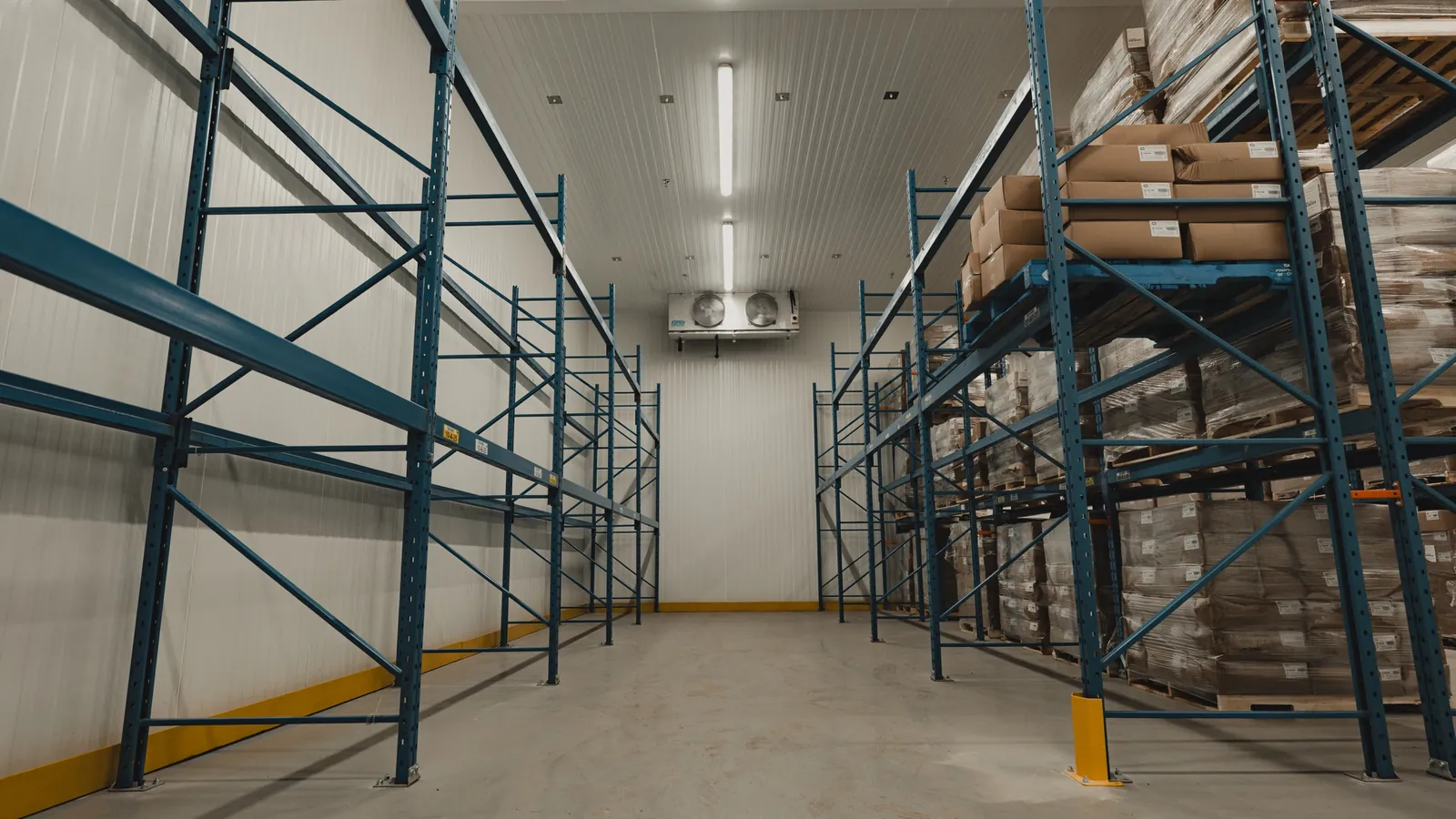
The evaporator can only cool air that reaches it. Heatcraft’s placement rules say “the air pattern must cover the entire room,” and one overstocked delivery day can undo that.
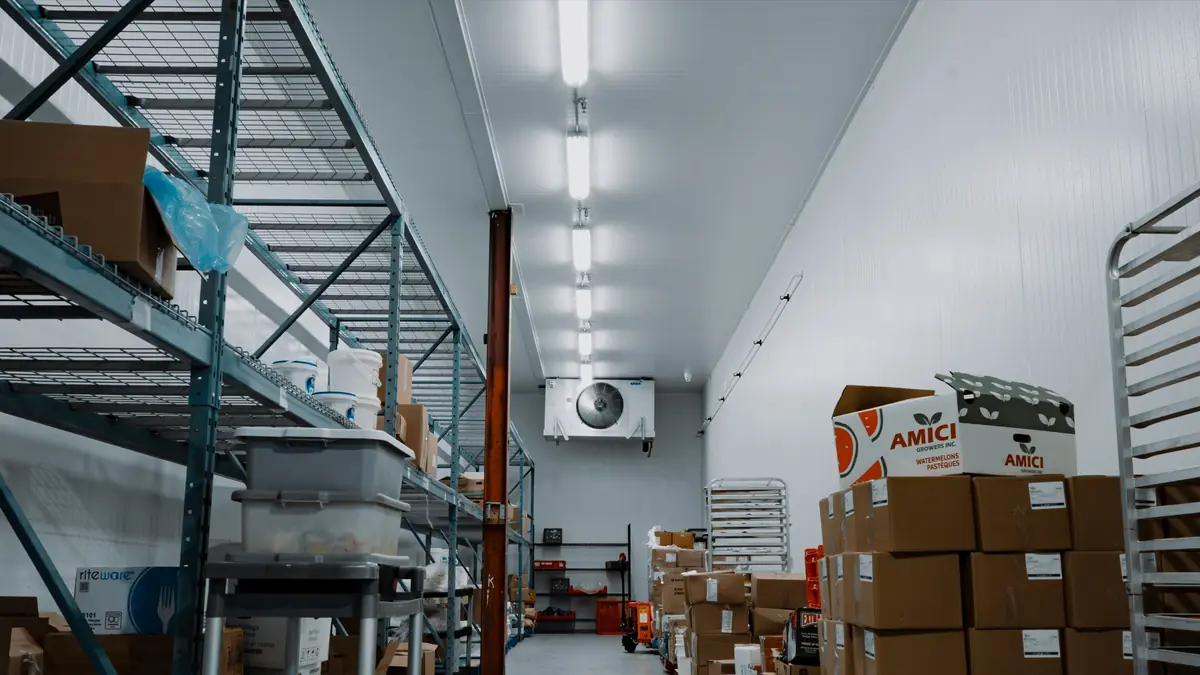
- Clearance below the unit: per the manual, “Leave space equal to unit height between bottom of unit and product.”
- Nothing before the fans: the same note continues, “Do not stack product in front of fans.”
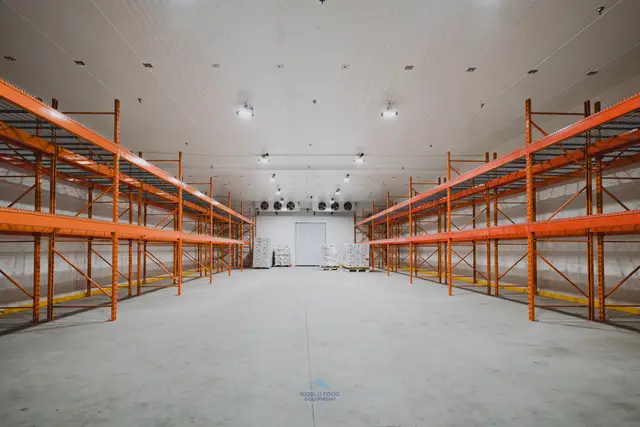
- Aisles and racking: Heatcraft designs evaporator placement around the “location of aisles, racks, etc.” Racking added after the install can block an air path the design relied on.
- Dial versus probe: if the controller and a product probe still disagree with good airflow, our walk-in cooler temperature guide explains why the two numbers differ.
The condensing unit: where the heat has to leave
A cooler moves heat out of the box and the condensing unit dumps it into the surrounding air. If that air cannot move, the system struggles most on the hottest days, which is when you need it most. Heatcraft lists a dirty condenser coil under both high discharge pressure and a tripped compressor thermal protector.
- Free air: Heatcraft says a condensing unit must sit “so that air may circulate freely and not be recirculated,” with every side at least one unit-width from any wall or obstruction.
- Operator housekeeping: move stored boxes, pallets, and bins away from the unit, and clear leaves or snow you can reach from the ground. A rooftop unit is the technician’s to clear. Keep hands and tools out of the unit itself.
- Coil cleaning: NRCan’s wording is “clean the condenser coils and fan regularly. Accumulated dust and debris can restrict airflow, causing the motor to work harder and use more energy.” Heatcraft’s maintenance schedule puts condenser cleaning at twice a year.
- The measured effect: an ENERGY STAR article reports a field study in which coil cleaning cut energy use by an average of 17 percent across mixed refrigeration equipment. The sample was 10 units, so read it as direction, not a promise.
- Sun and summer: NRCan advises keeping outdoor coils shaded, because “direct sunlight can overheat the coils, reducing efficiency and even causing mechanical failure.”
Where the condensing unit sits decides how hard this gets. Our guides to self-contained versus remote refrigeration units and outdoor versus indoor walk-ins cover placement in an Ontario climate.
Where the operator’s job stops in Ontario
Work on the refrigerant circuit, the control wiring, and the electrical supply is licensed work in Ontario, and the line is drawn by law, not by caution. A provincial refrigerant regulation, a compulsory trade, and the electrical licensing rules set it.
- 313A is compulsory: Skilled Trades Ontario classes Refrigeration and Air Conditioning Systems Mechanic as a compulsory trade. Anyone practising it must hold a certificate or a registered training agreement, and certificate holders appear on the public register.
- An ODP card alone: the province states that “you cannot work on or fix refrigeration equipment with only an ODP certificate card.”
- No venting: section 19 of Ontario Regulation 463/10 says “no person shall discharge or permit the discharge of refrigerant” into the natural environment or within a building.
- No topping up: under section 23, leaking equipment carries a notice that “no person shall add a refrigerant to the equipment until the leak is repaired.” Section 25 allows a refill only by a certified person, with a leak-test notice no more than six months old showing no leaks.
- One narrow exception: section 25 relaxes the notice rule where there is no reasonable alternative and food at a packing, processing, or storage facility is in immediate danger. The certified person is still required.
- Electrical faults: the Electrical Safety Authority says Licensed Electrical Contractors “are the only businesses, with certain exemptions, in Ontario legally authorized to do electrical work in your home or facility.”
How to check a technician on the public register is in our installer licensing checklist.
What to have ready when you call
The first minutes of any call are questions. Having the answers ready gives the technician a head start on the diagnosis and on the parts to load.
- The symptom: what runs, what does not, and what the display says, in the terms of the table above.
- Two temperatures: the setpoint and the current box reading, plus a product probe reading with the time.
- The timeline: when the box was last normal, and anything that changed since, such as a delivery, a power flicker, a deep clean, or other trades on site.
- The data plate: make, model, serial number, and refrigerant type from the plate on the evaporator or condensing unit.
- Age and history: the install year, the last maintenance visit, and any fault that keeps coming back.
- Your own checks: door seal, evaporator clearance, condenser airflow, and what you saw at the breaker panel.
WFE repairs walk-in coolers, walk-in freezers, and reach-ins of any brand across our service-area cities, with 313A-licensed technicians. The call-out fee is quoted on the phone before anyone drives out. Start on the walk-in cooler repair or replace page, which also works through whether an older box is worth the work.
Keeping a warm box from happening twice
Several causes in this guide build slowly: a coil loading with dust, a gasket flattening, a closer losing tension. They show up as an emergency on the first hot week of the year, but they were visible months earlier.
- Scheduled coil service: Heatcraft’s schedule calls for a visual inspection quarterly and condenser cleaning twice a year. On the boxes we install, scheduled maintenance covers coils, gaskets, drains, and defrost checks.
- Daily readings: read the box thermometer at open and close. A slow upward drift is easier to act on than a warm box at dinner service.
- A stocking line: mark the clearance below the evaporator so delivery day cannot bury it.
- Door discipline: run the paper test on every door a few times a year, and replace seals that fail it.
- A capacity question: a box that runs warm every August with clean coils and a tight door may be undersized for its load. That is a design conversation, and our walk-in cooler team can size it properly.
Before you pick up the phone
Protect the food, check the air paths, read the symptom, and then call. When a walk-in cooler is not cooling, the checks that belong to an operator take ten minutes and no tools. The refrigerant circuit, the control wiring, and the electrical supply belong to licensed trades in Ontario.
Frequently asked questions
Why is my walk-in cooler not cooling?
The operator-side causes are a door that is not sealing, product blocking the evaporator fans, a changed setpoint, or a condensing unit starved of air. The technician-side causes that manufacturer charts list include low refrigerant, an iced coil, a failed fan motor, tripped overloads, and a defective contactor. Check the first group, record what you see, and call a 313A-licensed technician for the second.
Why is my walk-in cooler running but not getting cold?
If the fans and the compressor both run and the box stays warm, start with Heatcraft’s chart for a room running too warm. It lists a thermostat set too high, low refrigerant, an iced coil, an evaporator too close to the door, and heavy air infiltration. Check the setpoint, the door seal, and the space around the evaporator, and leave refrigerant and coil problems to a licensed technician.
Why are the evaporator fans not running in my walk-in cooler?
Fans stop during a defrost cycle, so if the controller shows a defrost in progress, wait for it to end before assuming a fault. Beyond that, the manufacturer’s chart lists an open main switch, blown fuses, a defective motor, and a defective timer or defrost thermostat. All of those are jobs for a technician, not for kitchen staff.
How long can food stay in a walk-in cooler that stopped working?
Ontario’s Food Premises regulation gives no grace period: potentially hazardous food must stay at an internal temperature of 4°C or lower. Health Canada’s household guidance says an unopened refrigerator keeps food cold for about 4 hours, and that food held at room temperature for 2 or more hours should be thrown away. Let probe readings decide, and ask your public health unit when a call is unclear.
Can I add refrigerant to a walk-in cooler myself?
No. Ontario Regulation 463/10 allows only certified people to service refrigeration equipment, and it bars anyone from adding refrigerant to leaking equipment until the leak is repaired. A system that is low on refrigerant almost always has a leak, and sections 23 and 25 put the repair and a clean leak test before any refill.
Is a walk-in freezer that is not freezing the same problem?
Mostly yes: the same door, airflow, and condenser checks apply, and the same licensing line covers the refrigeration work. A freezer adds defrost faults, because a coil that does not clear its frost stops moving air. Our walk-in freezer ice guide covers that side in detail.
Plan Your Build
Size your walk-in in the configurator.
Set dimensions, doors, and refrigeration in 3D, then download the spec sheet to share.
Read Next
Plan a Walk-In Cooler or Freezer in 3D: 8 Decisions
The eight decisions that shape every walk-in cooler or freezer, and where to make each one in our free 3D configurator: size, type, panels, floor, doors, refrigeration, racking and lights.
Industrial Walk-In Freezers: What to Plan Before You Build
What changes when a walk-in freezer gets big enough for pallets and forklifts: the slab, the clear height, the doors, the refrigeration plant, and the Ontario rules that start to apply.
Walk-In Cooler & Freezer Doors: Types, Sizes, Options
Swing, sliding, pallet and roll-up doors for walk-in coolers and freezers: which one fits your traffic, the sizes we build to, what a freezer door adds, and the Canadian rule every walk-in door has to meet.
Walk-In Coolers — Custom Builds
See the service page for sizing, anatomy, and what's included in a WFE install.